


100+ Best Nursing Research Paper Topics for 2026: The Definitive Guide
By The Elite Academic Research Clinical Research Team | Reading Time: 12 Minutes | Target Grade: 1st Class / Distinction
What makes good nursing research paper topics in 2026?
A high-scoring nursing topic must be feasible (available data), novel (addresses 2026 tech or post-pandemic shifts), and clinically relevant (improves patient outcomes). Avoid over-saturated topics like basic hand hygiene unless you have a 2026 digital-tracking angle.
Struggling with your thesis? You aren’t alone. Between 12-hour clinical shifts and the pressure of AI-detection software, nursing students are under more stress than ever. Whether you are looking for dissertation topics in Nursing, seeking easy dissertation topics for undergraduates, or comparing the workload to dissertation topics in Business, Law, or Education, these nursing research paper topics master list is your roadmap to a Distinction.

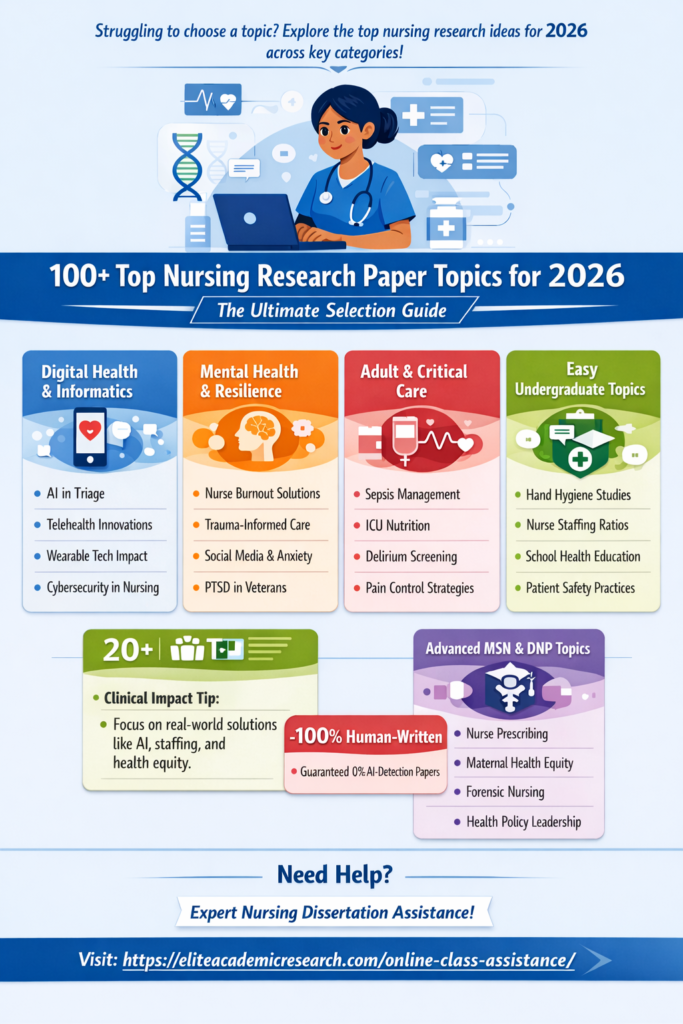
1. Digital Health & Nursing Informatics (20 Topics)
Focus: The 2026 intersection of data, AI, and patient safety.
- AI Triage Ethics: Impact of algorithmic decision-making on patient trust in ERs.
- Wearable Tech Accuracy: Comparing consumer-grade vs. medical-grade heart monitors for AFib detection.
- Telehealth in Geriatrics: Reducing readmission in rural elderly populations via remote biometric monitoring.
- Virtual Reality (VR) Training: Efficacy of VR simulation vs. traditional clinical practice for students.
- Cyber-Nursing: Protecting patient data privacy in the era of 2026 interoperable EHR systems.
- mHealth Adoption: Barriers to mobile health app usage among low-income diabetic populations.
- Smart Pumps: The role of ‘Smart’ infusion pumps in reducing medication errors in high-acuity wards.
- Robotic Mobility: Patient perceptions of robotic-assisted walking in post-stroke rehabilitation.
- Predictive Analytics: Using machine learning to predict ‘Patient Falls’ in orthopedic wards.
- Electronic Handovers: Comparing digital vs. verbal SBAR transitions during shift changes.
- Remote Wound Care: Accuracy of smartphone-based wound assessment in home-care settings.
- Big Data in Nursing: Using social media health trends to predict local viral outbreaks.
- Digital Literacy: Assessing the tech-fluency of senior nursing staff (55+) in a digital-first hospital.
- Alarm Fatigue: Using AI-filtered alarm systems to reduce NICU sensory overload.
- Digital Pills: Ethical implications of ingestible sensors for medication adherence in mental health.
- Blockchain Security: Using decentralized ledgers to secure nurse credentialing and licensing.
- Mental Health Chatbots: Efficacy of AI chatbots in preliminary screening for adolescent depression.
- Drone Delivery: The role of medical drones for emergency supplies in rural community nursing.
- Point-of-Care Testing: Bedside lab testing impact on trauma center decision-making speeds.
- Gamification: Using mobile games to improve physical therapy adherence in pediatric patients.
2. Mental Health & Workforce Resilience (20 Topics)
Focus: Staff wellbeing and psychological patient outcomes.
- Post-Pandemic Burnout: Long-term efficacy of ‘Resilience Workshops’ on nurse retention rates.
- Social Media Anxiety: Correlation between TikTok ‘algorithmic anxiety’ and adolescent self-harm.
- Secondary Trauma: The impact of ‘Moral Injury’ on nurses working in end-of-life care.
- Postpartum Depression: Evaluating nurse-led tele-counseling for mothers in underserved urban areas.
- Substance Abuse: The role of the nurse in ‘Safe Injection Site’ protocols: A 2026 qualitative study.
- Compassion Fatigue: Comparing oncology vs. emergency department nurses’ burnout levels.
- Lateral Violence: Impact of workplace bullying on the turnover of newly qualified nurses.
- Dementia Aggression: Non-pharmacological interventions for managing sundowning in memory units.
- Schizophrenia Support: Efficacy of nurse-led community groups in reducing patient relapse.
- Mindfulness at Work: Impact of 10-minute daily meditation on surgical nurse error rates.
- Suicide Risk: Barriers to effective risk assessment in General Practice nursing.
- Adolescent Bipolar: The role of the school nurse in managing medication side effects.
- Eating Disorders: Holistic nursing approaches to treating Bulimia Nervosa in male patients.
- Incarcerated Health: Mental health challenges and nursing interventions for prison populations.
- NICU Grief: Evaluating nurse-led bereavement support programs for grieving parents.
- Shift Work: Impact of the 4-day nursing work week on clinical performance and mental health.
- Sleep Deprivation: Impact of rotating shift patterns on the cognitive function of night nurses.
- Animal Therapy: Efficacy of therapy dogs in reducing pre-operative anxiety in pediatric surgery.
- Veteran PTSD: The role of the Nurse Practitioner in community-based veteran support systems.
- Social Isolation: Community nursing interventions to combat loneliness in the over-80s.
3. Adult, Critical Care & ICU Nursing (20 Topics)
Focus: High-acuity environments and specialized clinical interventions.
- Sepsis Six: Impact of nurse-led implementation of sepsis bundles on ward mortality rates.
- Early Mobility: Barriers to mobilizing mechanically ventilated patients in the ICU.
- Wound Care Tech: Silver-impregnated vs. honey-based dressings for chronic diabetic ulcers.
- Non-Opioid Pain Management: Interventions for post-op pain in patients with prior opioid dependency.
- MAID Ethics: The nurse’s role in ‘Medical Assistance in Dying’ discussions: A 2026 update.
- VAP Prevention: Efficacy of ‘Oral Care Bundles’ in reducing Ventilator-Associated Pneumonia.
- Pressure Ulcers: Comparing turning-clocks vs. pressure-sensing mattresses for skin integrity.
- Renal Transplant: Barriers to long-term medication adherence in post-transplant patients.
- Cardiac Rehab: Evaluating the success of home-based vs. clinic-based rehab post-Myocardial Infarction.
- Stroke Speech Therapy: Impact of early nurse-led interventions on long-term aphasia outcomes.
- Enteral Nutrition: Timing of tube feeding and its impact on ICU recovery speed.
- Delirium Screening: Accuracy of the CAM-ICU tool when used by junior vs. senior nurses.
- ABCDEF Bundle: Barriers to implementing the ‘ICU Liberation Bundle’ in private vs. public hospitals.
- Family Presence: Impact of 24-hour ICU visiting hours on patient cortisol levels and stress.
- Triage Fast-Tracking: Impact of digital triage systems on waiting times in urban ERs.
- Glucose Monitoring: Manual vs. continuous monitoring success in major surgical patients.
- Nocturnal Dialysis: Quality of life assessment for patients on long-term home hemodialysis.
- Surgical Pre-hab: Role of pre-operative physical exercise in reducing post-op complications.
- DVT Compliance: Compliance rates with compression stockings in orthopedic post-op patients.
- IV Success Rates: Ultrasound-guided vs. traditional cannulation in difficult-access patients.
4. Easy Dissertation Topics for Undergraduates (20 Topics)
Focus: High secondary data availability—perfect for finishing quickly.
- Hand Hygiene: Impact of automated sink sensors on hand-washing frequency.
- Staffing Ratios: Systematic review of nurse staffing levels vs. frequency of patient falls.
- Childhood Obesity: The nurse’s role in nutritional education in primary schools.
- Ward Noise: Evaluating the impact of hospital noise levels on patient sleep and recovery.
- SBAR Communication: Role of standardized tools in improving nurse-to-physician handovers.
- Brief Interventions: Efficacy of nurse-led smoking cessation advice in primary care.
- Asthma Adherence: Barriers to inhaler compliance in adolescent asthma patients.
- Breastfeeding Duration: Impact of nurse-led workshops on success in first-time mothers.
- Vaccine Hesitancy: Addressing parental concerns through community nurse education.
- Residential Care Hydration: Improving fluid intake in care homes via ‘Hydration Stations.’
- Patient Privacy: Qualitative study on maintaining dignity in multi-occupancy wards.
- Nurse Attire: Impact of scrubs vs. formal uniforms on patient-nurse trust and rapport.
- Discharge Literacy: Barriers to understanding discharge instructions in non-native speakers.
- School Nursing: The role of the school nurse in preventing STIs among teenagers.
- Barrier Creams: Systematic review of creams in preventing incontinence-associated dermatitis.
- Antenatal Exercise: Barriers to physical activity in women with high-risk pregnancies.
- Diabetes Peer Support: Impact of community groups on long-term HbA1c levels.
- Bedside Handovers: Comparing bedside vs. nurses’ station handovers for patient safety.
- Statin Adherence: Impact of patient education on managing long-term side effects.
- Media Perception: How TV portrayals of nursing affect student recruitment in 2026.
5. Specialized MSN & DNP Project Ideas (20 Topics)
Focus: Leadership, policy, and Evidence-Based Practice (EBP).
- ER Overcrowding: ROI analysis of nurse-led community clinics on local ER wait times.
- Maternal Equity: Reducing racial disparities in mortality via ‘Implicit Bias’ training for midwives.
- Pharmacogenomics: The nurse’s role in personalized oncology care plans based on genetic data.
- Prescribing Authority: Impact of nurse-led prescribing on rural patient access to care.
- Leadership Styles: Correlation between ‘Transformational Leadership’ and nurse job satisfaction.
- Green Theatres: Cost-benefit analysis of transitioning to sustainable medical textiles.
- Informatics Rollout: Implementation of ‘Super-User’ models for new EHR hospital-wide rollouts.
- Emergency Preparedness: Evaluating nurse response times in simulated ‘Mass Casualty’ scenarios.
- Refugee Health: Impact of nurse-led vaccination programs in temporary camp settings.
- Forensic Protocols: Improving evidence collection accuracy in cases of sexual assault.
- Chemo-Induced Alopecia: Efficacy of scalp-cooling technology: A Quality Improvement project.
- Vascular Access: Establishing a nurse-led ‘PICC Line’ insertion service: An EBP project.
- Water Birth Outcomes: Impact on second-stage labor duration in low-risk midwifery units.
- Ethics Committees: The role of the DNP in navigating ‘Withdrawing Life Support’ conflicts.
- Mental Health Handoffs: Improving ‘Warm Handoffs’ between inpatient and outpatient care.
- Wound Taskforce: Developing a ‘Pressure Ulcer Prevention Team’ in long-term care facilities.
- Ketogenic Interventions: Impact of nurse-led diet education on drug-resistant epilepsy.
- Clean Air Advocacy: The public health nurse’s role in lobbying for urban ‘Clean Air’ laws.
- Pediatric Screenings: Integrating routine mental health check-ups into pediatric primary care.
- Executive Boardroom: Impact of ‘Nurse Board Representation’ on hospital-wide safety metrics.
Why Nursing Research is Different in 2026
The biggest threat to nursing students today is the AI-Detection Trap. Universities are using 2026-grade stylometry to catch AI-generated papers. Because nursing is a “Life and Death” field, academic misconduct can result in a permanent ban from professional practice.
How Elite Academic Research Can Help
Writing 10,000 words while working clinical shifts is a recipe for burnout. Our Nursing Dissertation Writing Service provides:
- 100% Human-Written Guarantee: Certified 0% AI-detection reports.
- PhD-Qualified Nurse Writers: We speak the language of clinical care.
- PRISMA & SPSS Mastery: We handle the complex methodology and data analysis.
Why Students Trust Our Professional Nursing Research Paper Writing Service
In 2026, the complexity of clinical rubrics and the threat of AI-detection have made “DIY” research a high-risk gamble. Whether you need to buy a nursing research paper that is guaranteed to pass Turnitin or you require specialized nursing research proposal help to get your topic approved by your ethics committee, our team is the industry gold standard.
Here is why 95% of our clients achieve a Distinction:
1. Access to Elite Nursing Research Paper Writing Service
We don’t just “write essays.” We provide a comprehensive nursing research paper writing service that includes primary data collection, secondary thematic analysis, and full PRISMA systematic reviews. Our writers are not generalists; they are specialists in high-acuity, community, and psychiatric nursing.
2. Expert Nursing Research Proposal Help
Before you can write your dissertation, you must pass the “Proposal Gate.” We provide the nursing research proposal help you need to define your methodology, justify your sample size, and outline your theoretical framework (such as Peplau’s or Orem’s).
3. Human-Only, Professional Nursing Essay Writers
If you choose to buy a nursing research paper from a cheap “essay mill,” you risk receiving AI-generated content that will be flagged instantly. Our professional nursing essay writers are PhD-level practitioners who write with “clinical nuance.” We guarantee:
- 0% AI Probability: Every sentence is crafted by a human.
- 2026 Evidence-Based Sources: We only use peer-reviewed journals from the last 3–5 years.
4. Mastery of PICOT & Clinical Rubrics
Our nursing research paper writing service is built around the rubrics used by top universities in the UK, US, and Australia. We ensure your paper follows the PICOT framework and includes the “Critical Synthesis” required to move your grade from a “Pass” to a “First-Class” mark.
Frequently Asked Questions (FAQ): Nursing Research & Academic Papers
Q: What is the most common framework for a nursing research paper?
A: In 2026, the PICOT framework (Patient, Intervention, Comparison, Outcome, and Time) remains the gold standard for clinical research. Most supervisors expect you to use PICOT to refine your research question before you begin your literature search.
Q: Can I get help with a Nursing Reflective Journal or Gibbs’ Reflective Cycle?
A: Yes. Reflective writing is a core part of nursing placement modules. Whether you are using Gibbs’, Johns’, or Kolb’s model, our [Nursing Writing Service] can help you bridge the gap between clinical experience and academic theory, ensuring your reflection shows high-level “criticality.”
Q: What is the difference between a Nursing Systematic Review and a Literature Review?
A: A standard Literature Review summarizes existing research on a topic. A Systematic Review is much more rigorous; it requires a predefined search strategy, specific inclusion/exclusion criteria, and often a PRISMA flow diagram to document exactly how you found your sources.
Q: How do I choose between a Qualitative and Quantitative nursing paper?
A: It depends on your goal. Qualitative research explores the “lived experience” of patients or nurses (interviews/focus groups). Quantitative research tests a hypothesis using numerical data (statistics/trials). If you are stuck on the math, our statisticians specialize in SPSS and Excel data analysis for nursing students.
Q: Do nursing research papers require a specific referencing style?
A: Most nursing schools require APA 7th Edition or Harvard referencing. Accuracy is vital; incorrect citations are one of the most common reasons students lose marks. We provide fully cited papers with 100% accurate bibliographies using the latest 2026 sources.
Q: What are “Nursing Care Plan” assignments, and can you help with them?
A: Nursing Care Plans (NCPs) require you to identify NANDA-I nursing diagnoses, set goals (NOC), and plan interventions (NIC). We can assist in creating comprehensive, evidence-based care plans for complex case studies, from acute respiratory distress to chronic psychiatric management.
Q: How can I ensure my nursing paper passes an AI detector like Turnitin?
A: The only way to be 100% safe in 2026 is to avoid “AI bypassers” and write (or hire) human-only content. Because nursing requires specific clinical terminology, AI often flags “robotic” phrasing. Our Human-Only Writing Guarantee ensures your paper has the natural “clinical voice” that AI simply cannot replicate.





 OVER
OVER RATING
 YEARS
YEARS


